The development of digital technologies in the construction industry has made the design and delivery of prefabricated buildings much more integrated, predictable and efficient than in the traditional model of project delivery. One of the most important tools supporting modern construction is BIM (Building Information Modelling) technology. In the case of prefabricated structures, BIM plays a particularly important role, as it makes it possible to coordinate the design, production, logistics and assembly process even before work begins on site. This makes it possible to significantly shorten construction times, reduce execution errors and reduce the cost of the entire project.
Concrete prefabrication is based on the production of structural elements under factory conditions and their subsequent assembly on site. Unlike traditional construction, most of the preparatory work is done much earlier. This means that any design errors, installation collisions or geometric inconsistencies can lead to serious problems during the installation of the finished elements. This is why BIM technology is so important in prefabrication - it allows potential problems to be detected as early as the digital modelling stage, before prefabrication production begins.
The basis of BIM is a central digital model of the building, containing geometrical, material, technological and operational information. This model is a common working environment for all participants in the investment process: architects, constructors, sanitary and electrical designers, prefabrication manufacturers, contractors and the investor. The modern approach to investment management is increasingly moving away from the traditional „design-build” model to an IPD (Integrated Project Delivery) model, which involves close cooperation between all trades from the earliest stages of the investment. Thanks to BIM, it is possible to conduct this collaboration in real time, which significantly speeds up the decision-making process and eliminates many organisational problems.
One of the most important aspects of BIM in prefabrication is inter-industry coordination. In the traditional design process, the various trades often work independently of each other, leading to numerous collisions between structural elements and installations. In BIM technology, all trades work on a common model or models coordinated using data exchange formats such as IFC (Industry Foundation Classes) and BCF (BIM Collaboration Format). This makes it possible to analyse the interrelationships between structural elements, HVAC installations, cable routes or process equipment in real time.
Particularly important in prefabrication is the detection of clashes even before the components are manufactured. BIM technology distinguishes between several types of collision. Hard collisions occur when two elements physically overlap, e.g. a ventilation duct crosses a precast beam. Soft collisions refer to situations where the spacing between elements is insufficient for correct installation or operation. Logical collisions, on the other hand, refer to technological and organisational problems, e.g. the impossibility of installing a component due to an incorrect sequence of works. Automatic detection of such problems avoids costly changes on site and significantly reduces the risk of delays.
BIM also enables the design of prefabricated elements at a very high level of detail, referred to as LOD (Level of Development). Models with a high LOD level take into account not only the basic dimensions of the elements, but also reinforcement, connections, assembly accessories, process openings and transport elements. This makes it possible to faithfully reproduce the actual prefabricated element even before it is made in the production plant. This approach significantly reduces the time taken to prepare workshop documentation and reduces the risk of production errors.
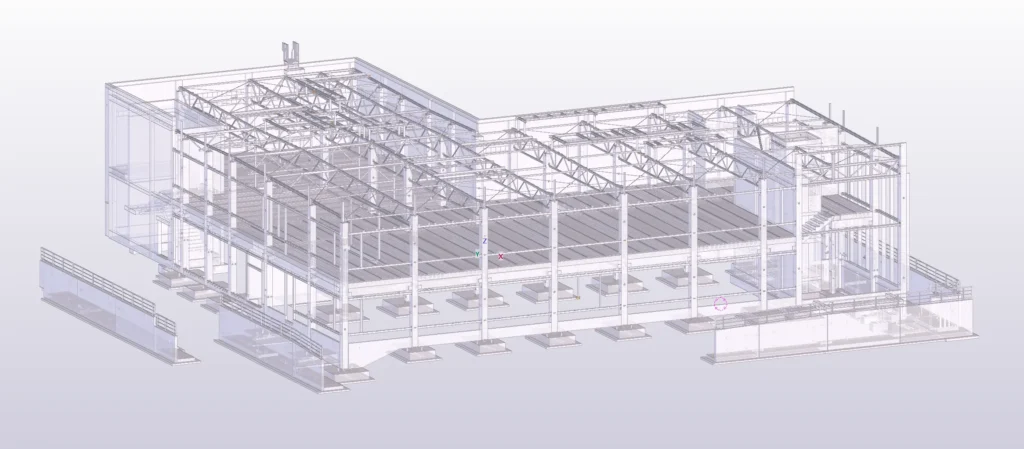
Modern BIM software enables the automatic generation of shop drawings, bills of materials and production lists. In practice, this means that a change in the digital model automatically updates the technical documentation. This eliminates the need to manually apply changes to multiple drawing sheets, which in traditional design was very time-consuming and often led to mistakes. In prefabrication, this is of great importance, as the production of components takes place in series and requires the documentation to be fully consistent with the actual model of the structure.
Integration of BIM into the production process is another element contributing to reduced lead times. Today's prefabrication plants increasingly use automated process lines and CNC machines. Data from the BIM model can be directly exported to ERP systems and the production equipment responsible for cutting, bending or welding the reinforcement elements. This reduces the number of manual operations and reduces the risk of errors due to incorrect reading of documentation. The production process is also based on material requirements planning (MRP). The basis of the MRP system's operation is the calculation of material resources, which, for the prefabrication plant, determines the delivery schedule for raw materials and the production schedule. Thanks to BIM and digital construction models, it is possible to efficiently determine the material requirements for the production of components.
The ability to plan production and logistics based on a digital model is also an important aspect. Each prefabricated element can have an individual identifier containing information on the place of assembly, production date, transport method and order of construction. This approach optimises the delivery schedule and reduces the storage of components on site. In practice, this means shorter assembly times and less downtime due to logistical problems.
BIM also significantly improves the assembly process of prefabricated structures itself. Thanks to 3D models, it is possible to analyse in advance the course of the assembly, the positioning of cranes, transport routes or storage zones for prefabricated elements. Increasingly, 4D models are also being used, which combine the spatial model with the work schedule. This makes it possible to simulate the course of construction over time and to identify potential organisational conflicts even before work begins. As a result, installation proceeds faster, more predictably and with less risk of downtime.
It is also worth noting the importance of BIM in terms of information management and communication between project participants. The traditional documentation workflow based on paper drawings and email correspondence is very time-consuming and error-prone. In a BIM environment, all participants in the process have access to the current version of the model, which eliminates the problem of working on outdated data. Cloud-based platforms allow multiple project teams to work simultaneously and quickly submit comments and design changes.
BIM technology has a significant impact on reducing investment costs. Although the implementation of BIM involves the purchase of specialised software and the training of staff, the benefits of reducing errors, shortening design and construction times and optimising production processes far outweigh the initial costs. In prefabrication, particularly large savings come from a reduction in the number of on-site corrections and better use of materials and production resources.
In summary, BIM technology is one of the most important tools supporting the development of prefabrication in modern construction. With its ability to create detailed digital models, interdiscipline coordination, documentation automation and integration into production and assembly processes, BIM significantly reduces the design and construction time of prefabricated structures. It also reduces errors, optimises logistics and increases the quality and predictability of the entire investment process. Today's construction industry is increasingly moving towards full digitalisation of design and execution processes, and BIM-supported prefabrication is becoming one of the most important developments in the construction industry.
Content compilation: Rafał Obidowski

